A newly released Global Education Monitoring report and African Centre for School Leadership Spotlight Report titled Lead for Foundational Learning show that just 12 percent of children in Ethiopia complete primary education and achieve minimum learning proficiency.
The report, shared with Addis Standard by UNESCO, shows overall learning levels across Africa are also lower than previously thought.
A new policy dashboard is launched alongside the Spotlight Report maps policies and practices supporting foundational learning to encourage concrete action by governments. Among key policy areas highlighted, the report stresses the need to strengthen the role of school leaders in improving learning outcomes.
According to UNESCO, Ethiopia already has four out of six essential school leadership policies in place. However, the country has yet to implement two key measures: mandating induction programs for new principals to ensure they are adequately prepared for their roles, and embedding national professional standards or competencies for school principals within national laws or policies.
The report comes on the heels of several factors that have further strained Ethiopia’s already fragile education system. Addis Standard’s recent reporting reveals that in regions such as Amhara, Oromia, and Tigray, schools are facing dire challenges stemming from the combined effects of wars, displacement, and resource shortages. In many areas, classrooms have been destroyed or repurposed for emergency shelters, teachers remain unpaid or displaced, and thousands of children have been forced out of school entirely. Beyond conflicts, persistent budget constraints, food insecurity, and inadequate infrastructure have deepened the crisis, leaving regional education bureaus struggling to restore normal learning conditions.
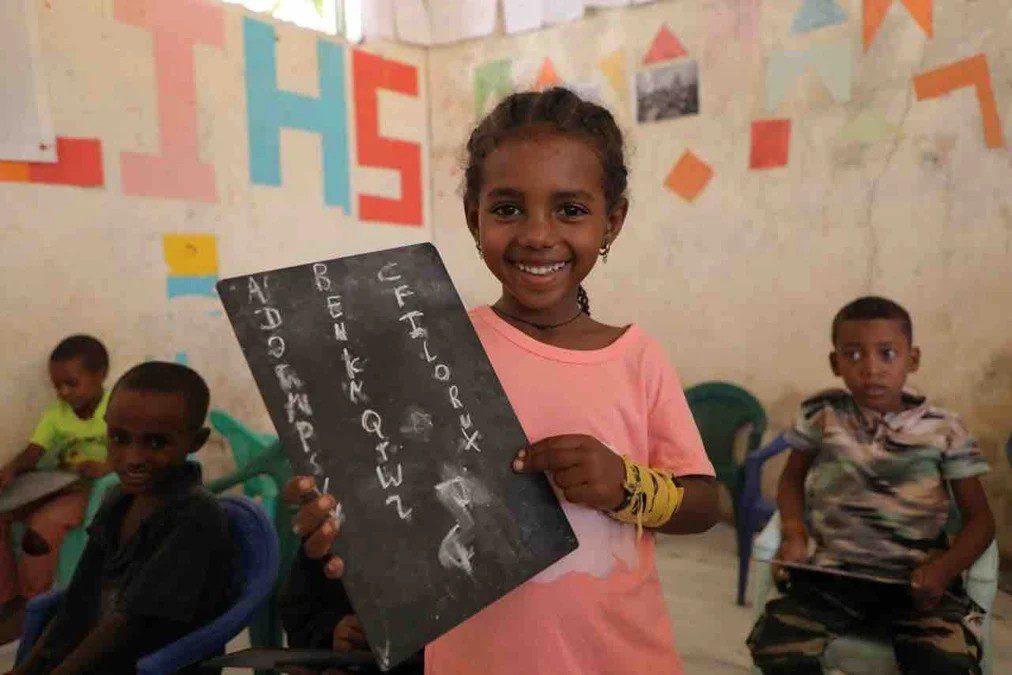
Although the news report recognizes the contribution of Ethiopia’s large-scale school feeding program, which supports children’s learning, it adds a new dynamic: the importance of maintaining minimum learning standards. Ethiopia’s school-feeding program is 65 percent government subsidized and currently reaches 38 percent of all primary school children, compared to an average of 43 percent across the continent, the reports notes.
The importance of mother-tongue education is another areathe reportcommends Ethiopia. However, it notes that Ethiopia does not yet have a national learning assessment framework, a tool that only 20 percent of African countries have established to measure and align learning objectives across education systems.

“The most concerning element is not just that learning levels are so low, but that systems are operating in the dark,” said Manos Antoninis, Director of the Global Education Monitoring Report at UNESCO. “When only 20% of countries have national assessment frameworks in place, it means the vast majority lack the clear learning objectives required to drive targeted reform. Until countries invest in robust data and clear targets, even the most dedicated school leaders will continue fighting this crisis with one hand tied behind their backs.”

Squeezed financing for education, with aid to education in low-income countries accounting for only 12 percent of total education spending, including household contributions, another area the report warned. Based on current donor portfolios and announced reductions, the GEM Report estimates that aid to education in Ethiopia could shrink by USD 33 million, potentially undermining progress toward quality education.
The report forwarded three key recommendations aimed at strengthening the capacity of school leaders and improving learning outcomes. It calls on countries to “ensure school leaders monitor learning with data to help struggling learners improve,” emphasizing that effective leaders “set clear learning goals, prioritize teaching and learning, support and motivate teachers, and foster collaboration within school communities.”
The report further urges governments to “select, prepare, and support school and system leaders as instructional leaders,” noting that while 35 percent of countries, including Ethiopia, have competency frameworks guiding selection, training, and professional development, “only 19 percent require principals to undergo prior training before assuming their roles.”
Finally, it recommends that education officials’ capacity be developed “to understand and apply learning objectives,” adding that district education officers should have “clear, measurable learning goals linked to their evaluations” and receive “targeted professional development to strengthen instructional leadership and data-driven quality assurance.”
In a news analysis published by Addis Standard in September 2025 under the title “From classrooms to military camps: Years of conflict in Oromia push millions of children out of school,” residents reported that students have been forced out of classrooms as many schools remain closed or destroyed amid the seven-year-long conflict in the region.
Addis Standard spoke with community members in the Ada’a Berga district of West Shewa, the Nejo district of West Wollega, and the Kuyyu and Yaya Gulale districts of North Shewa, who said persistent violence has forced schools to shut down, leaving children without access to education.
In Ada’a Berga district alone, residents said at least ten primary and secondary schools have closed. According to the residents, Adada Sodolbe, Golole, Dhaku Mute, Ilu Sodolbe, Kore Jeno, Ejere, Sapera, Oda Dalota, Olenkomi Secondary, and Karkaresa Secondary are some of the schools that have ceased operations.
Similarly, in Tigray nearly 1.2 million children, 46% of Tigray’s school-age population, are out of school this academic year according to the regional Bureau of Education.
According to the Bureau, 2.53 million students were expected to enroll across Tigray, but only 1.36 million have registered, leaving more than a million out of school.
Further, in a statement shared with Addis Standard, the Tselemti Development Association revealed that schools in three districts of Tselemti, home to more than 250,000 people, have remained closed for six consecutive years since 2020 due to COVID-19 and the subsequent war. According to the association, prior to the conflict, more than 56,000 students were enrolled across 79 schools in the districts.
Similar to the situation in Oromia and Tigray, the Amhara region has also faced major disruptions in education. Only 2.9 million students were registered to attend school this academic year, far below the regional target of 7.4 million. In September 2025, the head of the Amhara Regional Education Bureau told local media, “Our registration plan is to enroll around 7.4 million students to make up for the learning losses from last year and the year before. As of September 12, close to 2.9 million students have been registered.”
Data from UNICEF shows that 4.4 million children in Amhara did not attend school during the 2024/2025 academic year, the highest number in Ethiopia. Over the past two years, armed conflict and insecurity have prevented millions of students from returning to classrooms, leaving many areas with interrupted teaching and learning.
“Floods, droughts, the northern war, and the current state of instability have severely challenged the region’s education system,” Mulunesh added.